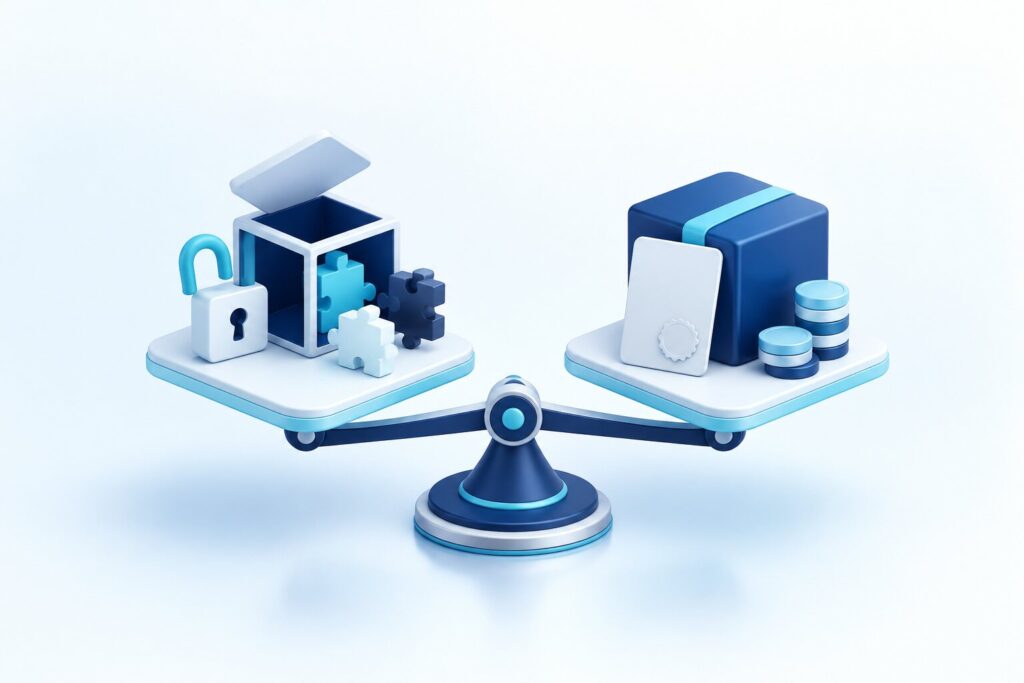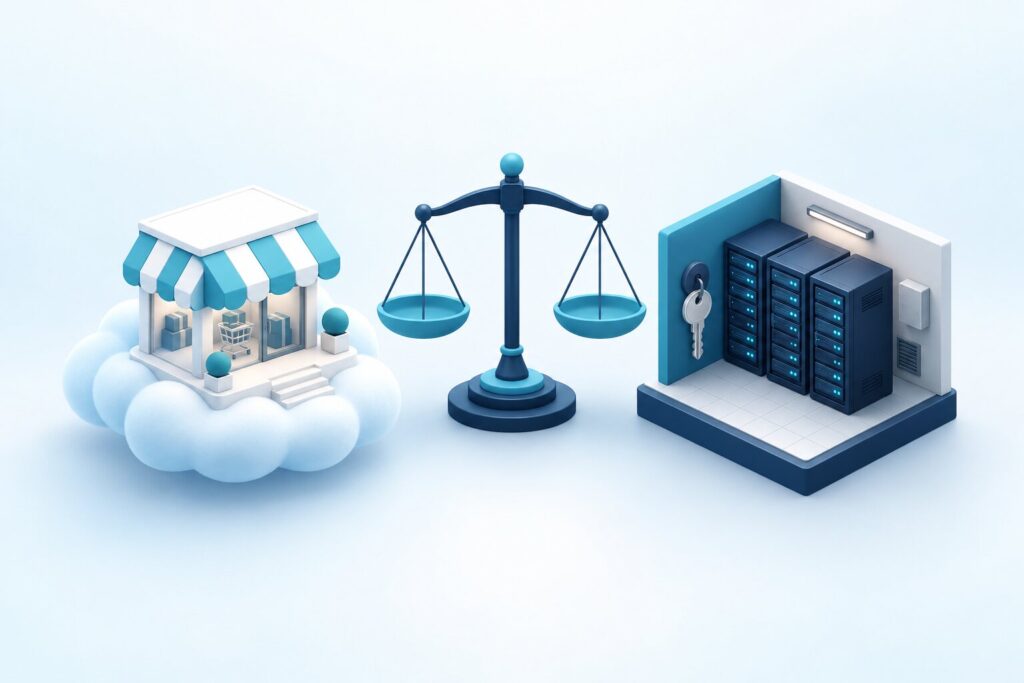
The choice between Adobe Commerce Cloud and self-hosting depends primarily on your available DevOps capacity, your budget and your scalability needs, because the two models build fundamentally different structures of responsibility around your store. In our experience, most executives approach this question solely from the license fee angle, when the real deciding factors are the total cost of ownership, security responsibility and how the day-to-day operational burden is split between the provider and your own team. In many cases, the success of a Magento or Adobe Commerce store depends not on the platform choice but on how well the hosting model actually matches the company’s internal capacity. This article sets out the pros and cons of both options across four key criteria (costs, scalability, DevOps needs and security) so your decision is well founded and backed by numbers.
Costs: license fee, hosting and hidden items
The most important takeaway from the cost comparison is that neither Adobe Commerce Cloud nor self-hosting is limited to the visible items you can compare at first glance, because both models involve significant hidden costs when you calculate the total cost of ownership. In our experience, the Adobe Commerce Cloud PaaS package ranges from $40,000 to $200,000 per year, including hosting. With self-hosting there is no license fee, but hosting, security monitoring and developer hours are billed separately, and for a mid-sized Magento store these can exceed $10,000 per month. In the cases we have examined, the decisive difference is not the size of the amount but its predictability: Adobe Commerce Cloud means a fixed, albeit higher, annual fee, while with the self-hosted model costs can fluctuate from month to month depending on traffic and troubleshooting needs.
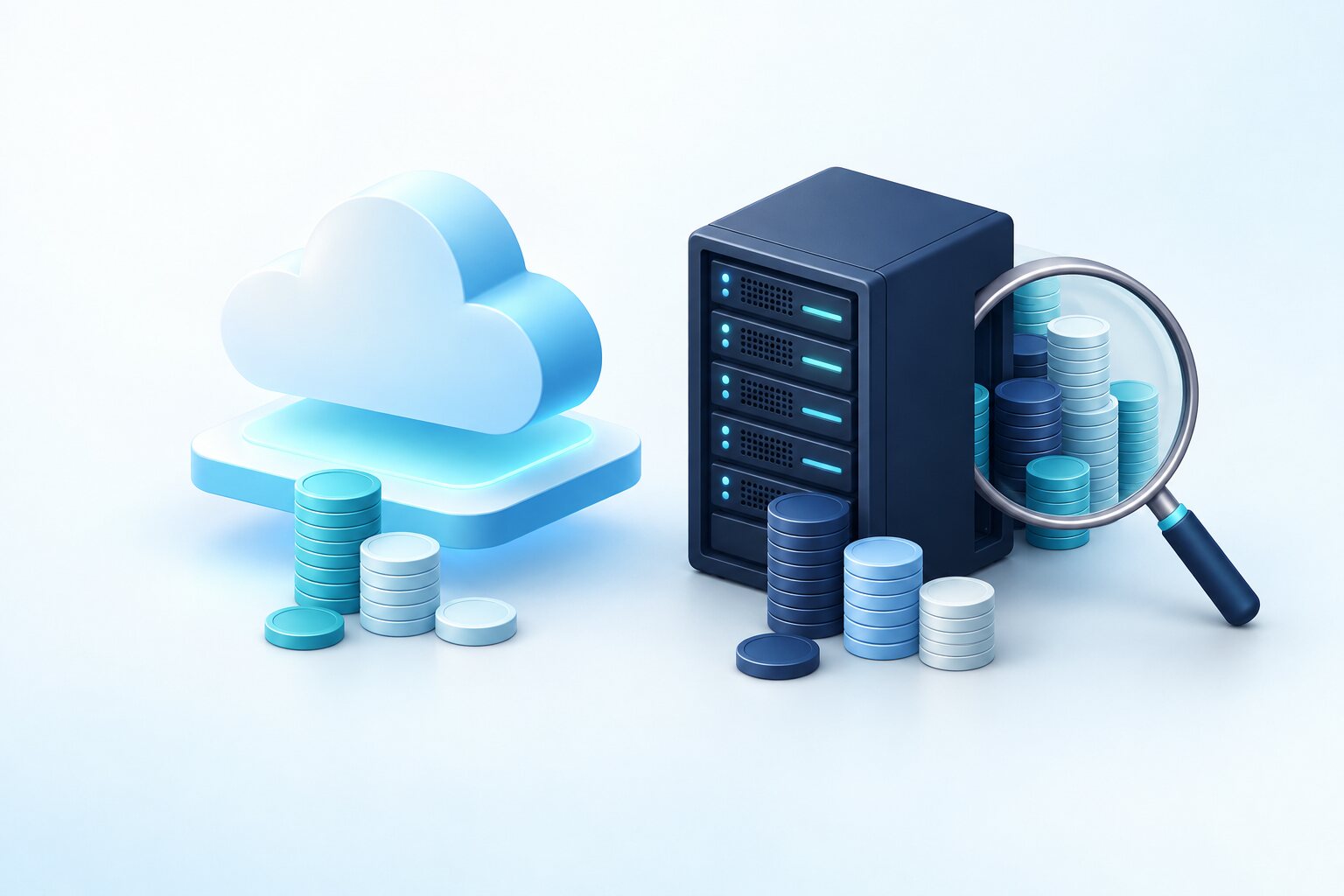
Which hidden costs should you prepare for with both models?
Hidden costs in both models include license fees for extensions and integrations, at $500–5,000 per extension per year, as well as the cost of custom theme development and ERP integration, which alone can range from $5,000 to $50,000. When you shouldn’t decide on the license fee alone: if your company has significant custom development or ERP integration needs, because these items can substantially change the final annual cost in both models, regardless of which hosting solution you choose.
Scalability and performance during traffic peaks
Scalability becomes especially critical for stores with seasonal campaigns such as Black Friday or Christmas sales, because the system then has to handle a significant traffic increase in a short time without downtime. In many cases, Adobe Commerce Cloud provides automatic scaling that expands server capacity on its own during traffic peaks and then returns to the baseline, which significantly reduces the need for manual intervention. We have seen this pattern across multiple projects: with self-hosted Magento operations, the same level of scalability is achievable, but it requires pre-planned, dedicated expertise and often manual or semi-automated capacity expansion, which depends on how well prepared the team is.
When is the self-hosted model worth choosing for scalability?
The self-hosted model is competitive in terms of scalability if the company has a hosting partner or in-house team that proactively plans and tests capacity expansion ahead of seasonal peaks, rather than just reacting to problems. Who shouldn’t rely on self-hosting to handle traffic peaks: companies without a dedicated, experienced hosting partner, because for them a sudden traffic surge carries a serious risk of downtime, which Adobe Commerce Cloud’s automatic scaling would significantly reduce.
| Criterion | Adobe Commerce Cloud | Self-hosting |
| Cost structure | Fixed, higher annual fee, including hosting | Variable, hosting and development billed separately |
| Scalability | Automatic, built in | Depends on planning and the partner |
| DevOps needs | Low, Adobe manages the infrastructure | High, dedicated expertise required |
| Security | PCI DSS Level 1, automatic patches | Your own responsibility, manual updates |
DevOps needs and security responsibility
The division of DevOps needs and security responsibility is the deepest structural difference between the two models, because with Adobe Commerce Cloud, Adobe itself handles much of the infrastructure management, server configuration and security patching, while with self-hosting this remains entirely the responsibility of the company or its partner. In our experience, most clients choose Adobe Commerce Cloud when they have no dedicated in-house DevOps capacity, because it keeps server management and security monitoring from becoming a constant burden on the development team.
Who is self-hosted, self-managed infrastructure better suited for?
Self-hosted, self-managed infrastructure is primarily suited to companies that have an experienced DevOps team or a reliable hosting partner, because it gives them full control over the server environment, configuration and cost optimization, which a fixed cloud package doesn’t allow. Should small businesses choose the self-hosted model without DevOps experience? Not really, because in that case the security risk and the chance of downtime rise significantly, and the license fee saved is quickly eaten up by troubleshooting and emergency costs.
When deciding between the two models, think through these criteria one by one:
- The company’s available DevOps and operations capacity.
- The store’s annual revenue and the scale of seasonal spikes.
- A comparison of the total cost of ownership: license, hosting, development and security.
- The level of security and compliance (PCI DSS) requirements.
- The complexity of existing or planned custom developments and integrations.
Before deciding which model to choose, also consider these practical points:
- Whether the company has a reliable, experienced Magento hosting and maintenance partner.
- How predictable or volatile the store’s annual traffic is.
- How much custom development and online store development will be needed in the long term.
- Which data protection and payment security compliance requirements apply to the company.
- How much time and internal resources are available for the transition after the decision.
Migration and transition risk between the two models
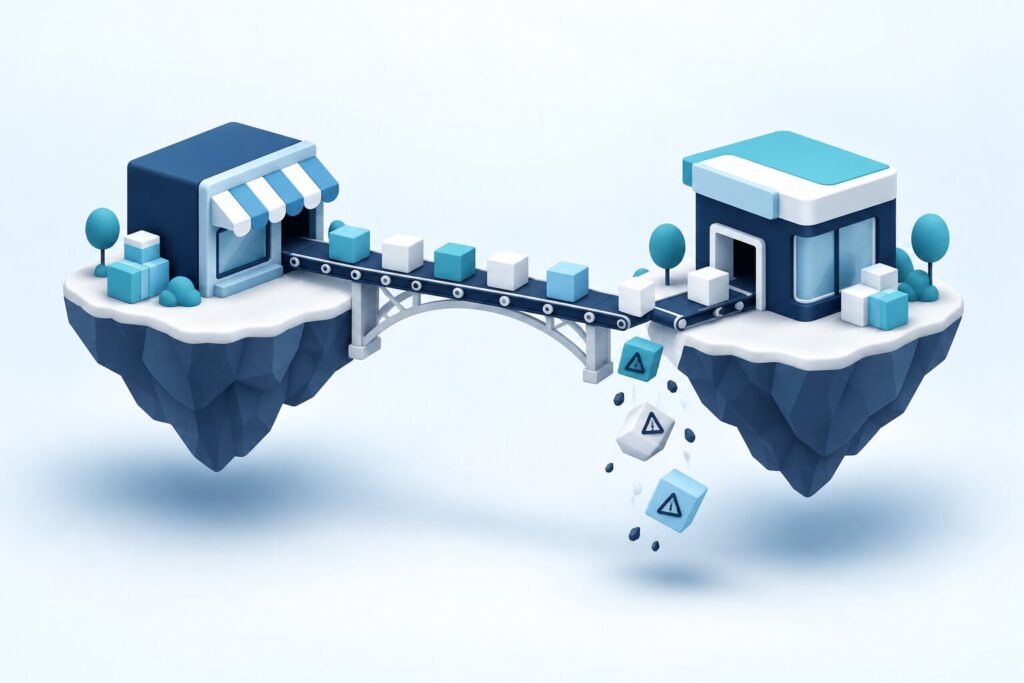
Migration becomes particularly important when a company wants to replace its current hosting model, because switching between Adobe Commerce Cloud and self-hosting requires significant technical effort and time in either direction. In our experience, most companies underestimate how long it takes to move a stable, live system, especially when the current infrastructure includes custom configurations or non-standard server settings. In the cases we have examined, moving from a self-hosted model to Adobe Commerce Cloud is typically simpler, because the target system is standardized, while the reverse direction, from Cloud to your own servers, often requires custom infrastructure design for things Adobe previously handled automatically.
Which steps reduce transition risk?
To reduce transition risk, it is essential to set up a parallel test environment in which the new infrastructure serves part of the real traffic before the full switchover. When you shouldn’t make the switch immediately, in a single step: if your store is approaching a seasonal peak, because instability during the transition could cause problems in exactly the most critical revenue period. That is why such switches should always be timed for a quieter business period.
How team size and internal expertise affect the decision
Company size and the level of internal technical expertise are often stronger deciding factors than the budget itself, because for a smaller team, offloading the DevOps burden can matter more than the license fee. In many cases we have found that mid-sized companies without a dedicated IT department are significantly better off with the Adobe Commerce Cloud model, because they can devote their development capacity to product development rather than server operations. We have observed this pattern in various industry contexts: at companies where the technical team specializes mainly in e-commerce features rather than infrastructure management, the self-hosted model placed a disproportionate burden on daily operations.
When does it make sense to build an in-house DevOps team for self-hosting?
Building an in-house DevOps team makes sense if the company is planning significant developments with custom infrastructure needs over a multi-year horizon, and full control over server management represents a business-critical competitive advantage. Who this investment is for: large enterprises whose traffic and complexity justify maintaining a permanent, multi-person operations team, because for them control and customizability are an investment that pays off in the long run, not an unnecessary cost.
Flexibility and customizability in the long term
Flexibility and customizability are especially important for companies with unique, industry-specific business processes, because the two models offer different degrees of freedom for deeper system modifications. In our experience, most clients choose a self-hosted, PaaS-based or self-managed model when their store needs non-standard, deep custom developments that a more restrictive, multi-tenant cloud service would struggle to accommodate.
What are the customization limits of the multi-tenant cloud model?
The limits of the multi-tenant cloud model show up mainly in deeper, core-level modifications, because the versionless, automatically updating architecture leaves less room for custom core changes than self-managed, single-tenant infrastructure. Is it worth accepting this limitation in exchange for convenience? For many mid-sized companies, yes, because most business needs can be met at the layer and extension level without touching the core code, while for complex B2B systems that truly require deep customization, this limitation can become a deciding factor.
Which hosting model is the right choice?
The right choice is never about which platform sounds more modern. It is about how well the company’s in-house DevOps capacity, the store’s traffic profile and its customization needs fit the structure of Adobe Commerce Cloud or self-hosting. In our experience, most mid-sized companies without a dedicated, multi-person IT operations team are better off in the long run with the Adobe Commerce Cloud model, because they can devote development capacity to product development rather than server management, while automatic scaling and built-in PCI DSS compliance significantly reduce day-to-day operational risk. In many cases, the companies that deliberately choose self-hosted, self-managed infrastructure are those that need deep, custom core-level development or that have a reliable, experienced hosting partner, because for them full control and flexibility represent greater business value in the long run than convenience.
In our experience, you should never make this decision based solely on the license fee or the monthly hosting bill, because in both models significant hidden costs (extension licenses, custom integrations, security monitoring) affect the total cost of ownership. Who the self-hosted model isn’t for without DevOps experience: companies without a reliable hosting partner, because for them the risk of sudden traffic surges and postponed security updates far outweighs the money saved on the license fee. Migration and transition risk are also important considerations: with a parallel test environment and a switch timed for a quieter business period, the risk of downtime can be significantly reduced in either direction. The right choice, then, doesn’t hinge on a single technology preference but on a deliberate assessment based on the company’s size, internal expertise and long-term growth plans.